Research Proposal: SH in the Army
SEXUAL HARASSMENT IN THE U.S. ARMY Angel Ruzicka , Ashlyn Pfister, Laura Urbin, and Natalie Fish D e p a r t m e n t o f C o m m u n i c a t i o n S t u d i e s , I n d i a n a U n i v e r s i t y C M C L - C 4 2 4 : C o m m u n i c a t i…
The first 11 pages are shown here. The PDF has all 12.
The text
Read out of the PDF, so the order can be a little off where the page had columns or boxes. The pages above are the real thing.
RESEARCH PROPOSAL:
SEXUAL HARASSMENT IN THE U.S. ARMY Angel Ruzicka , Ashlyn Pfister, Laura Urbin, and Natalie Fish D e p a r t m e n t o f C o m m u n i c a t i o n S t u d i e s , I n d i a n a U n i v e r s i t y C M C L - C 4 2 4 : C o m m u n i c a t i o n R e s e a r c h M e t h o d s D r . D a n i e l l e H a l l i w e l l A p r i l 2 7 , 2 0 2 2 RESEARCH PROPOSAL | 1
OVERVIEW
Sexual harassment is a major, recurring, and ever-growing issue within the U.S. Army. For the past several years, the U.S Army has been receiving extensive media coverage about the issue of sexual harassment in their ranks. The most recent data provided by US Department of Defense showed that 34,000 services members reported formal complaints about sexual harassment incidents in the year 2020 (2022). Sexual harassment within the U.S. Army, if left alone, will negatively impact members within the organization and could harm the military's ability to truly protect its people and country. With its slogan “This We’ll Defend,” the U.S. Army's responsibilities are to serve the American people and to protect the country and its national interests. The U.S. Army structure is diverse, ranging from active members, reserve members, multiple operational areas, administrative areas, functional areas, and sub-branches.
With so many people involved in this organization, the military serves as a trailblazer in many ways and could truly exemplify an organization that defends all its people. Although the Sexual Harassment/Assault Response and Prevention (SHARP) program is in place to reduce these incidents and provide resources for those who may have undergone a sexual harassment-related situation, improvements can be made to ensure the further safety of active U.S. Army Soldiers and to show the issue is taken seriously. If sexual harassment can contribute negatively to team cohesion, performance levels, and mental health, then the U.S. Military needs to be actively seeking research on the issue and ways to improve its preventive and supportive practices. Without properly addressing the issue of sexual harassment in the U.S. Army, service members will continue to suffer while trying to do the best for serving their country.
RESEARCH PROPOSAL | 2
PURPOSE
The objective of this study is to investigate sexual harassment and assault within the U.S. Army because we want to find out how the negative outcomes of these events affect team cohesion and soldiers’ mental health, in order to understand the ways in which the Army can improve their SHARP program and offer suggestions for a more comprehensive program for the future. Without addressing sexual harassment seriously even the most minute instances can harm the organization and unless Army personnel are finding ways to advance the SHARP program, it will reflect poorly on the U.S. Army’s credibility and ability for its members to serve the nation accordingly.
Military sexual trauma (MST) is a term coined from the Department of Veterans Affairs (VA), as according to researchers Valerie Stander and Cynthia Thomsen. The definition of MST as defined by referring to a specific veteran is, “psychological trauma, which in the judgment of a mental health professional employed by the Department [of Defense], resulted from a physical assault of a sexual nature, battery of a sexual nature, or sexual harassment which occurred while the Veteran was serving on active duty or active duty for training” (Stander and Thomsen, 2016). This definition of MST can exhibit the trauma and negative influence resulting from sexual harassment. The potential harm regarding mental health or psychological trauma is enough to encourage more reinforcement and efforts regarding the SHARP program because this is a liability to the Army. Ineffective practices on the issue can impact not only the mental health of victims, but the atmosphere when working within this organization.
The objective of this study is to investigate sexual harassment and assault within the U.S. Army because we want to find out how the negative outcomes of these events affect team cohesion and soldiers’ mental health, in order to understand the ways in which the Army can improve their SHARP program and offer suggestions for a more comprehensive program for the future. The focus of this study will allow for greater understanding of how exactly individuals are being impacted by sexual harassment within the U.S. Army and how they view current procedures which can be taken into consideration for improving the SHARP program. Adjustments within the SHARP program will allow for more preventative measures, resources, and overall effectiveness, as well as offering better support to individuals suffering from long-term effects.
RESEARCH PROPOSAL | 3
BACKGROUND ON THE ISSUE
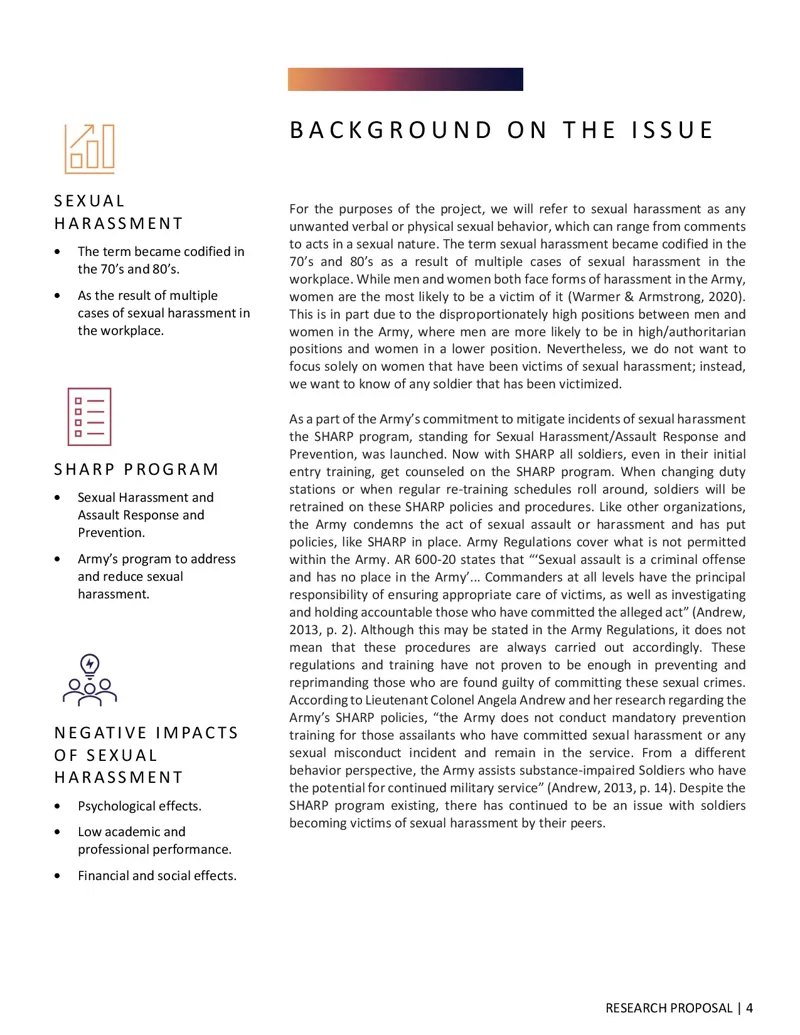
SEXUAL For the purposes of the project, we will refer to sexual harassment as any HARASSMENT unwanted verbal or physical sexual behavior, which can range from comments • The term became codified in to acts in a sexual nature. The term sexual harassment became codified in the the 70’s and 80’s. 70’s and 80’s as a result of multiple cases of sexual harassment in the workplace. While men and women both face forms of harassment in the Army, • As the result of multiple women are the most likely to be a victim of it (Warmer & Armstrong, 2020). cases of sexual harassment in This is in part due to the disproportionately high positions between men and the workplace. women in the Army, where men are more likely to be in high/authoritarian positions and women in a lower position. Nevertheless, we do not want to focus solely on women that have been victims of sexual harassment; instead, we want to know of any soldier that has been victimized.
As a part of the Army’s commitment to mitigate incidents of sexual harassment the SHARP program, standing for Sexual Harassment/Assault Response and SHARP PROGRAM Prevention, was launched. Now with SHARP all soldiers, even in their initial entry training, get counseled on the SHARP program. When changing duty • Sexual Harassment and stations or when regular re-training schedules roll around, soldiers will be Assault Response and retrained on these SHARP policies and procedures. Like other organizations, Prevention. the Army condemns the act of sexual assault or harassment and has put policies, like SHARP in place. Army Regulations cover what is not permitted • Army’s program to address within the Army. AR 600-20 states that “‘Sexual assault is a criminal offense and reduce sexual and has no place in the Army’... Commanders at all levels have the principal harassment. responsibility of ensuring appropriate care of victims, as well as investigating and holding accountable those who have committed the alleged act” (Andrew, 2013, p. 2). Although this may be stated in the Army Regulations, it does not mean that these procedures are always carried out accordingly. These regulations and training have not proven to be enough in preventing and reprimanding those who are found guilty of committing these sexual crimes. According to Lieutenant Colonel Angela Andrew and her research regarding the Army’s SHARP policies, “the Army does not conduct mandatory prevention NEGATIVE IMPACTS training for those assailants who have committed sexual harassment or any sexual misconduct incident and remain in the service. From a different OF SEXUAL behavior perspective, the Army assists substance-impaired Soldiers who have HARASSMENT the potential for continued military service” (Andrew, 2013, p. 14). Despite the • Psychological effects. SHARP program existing, there has continued to be an issue with soldiers • Low academic and becoming victims of sexual harassment by their peers. professional performance.
• Financial and social effects.
RESEARCH PROPOSAL | 4
While military leaders have researched and implemented programs to address the issue, there is still a lot of work necessary to effectively address the issue. The impacts of sexual harassment in the Army go beyond merely emotional responses. The impacts of sexual harassment include a multitude of negative effects, such as adverse psychological, academic, professional, financial, and social effects. Arguably the most concerning impact of sexual harassment was explored in a research study that found a link between military sexual assault (MSA) and “self-and other-directed violence” (Wilson et al., 2020). This could lead to a plethora of issues regarding the safety of not only U.S. Soldiers, but also any civilians that come into contact with any of the soldiers. Many civilians work on US military bases, and likely civilians are living near the base. These potential acts of violence could put everyone at risk of being injured. In addition to this, victims of sexual harassment may feel like they are unsafe in their units and face mental hardships. They could even struggle to focus and fail to do their jobs. It is also not rare for instances of sexual harassment, left alone to heighten into sexual assault and abuse. As the U.S. Army is comprised of America’s best to fight and serve, it is crucial to flush out proper strategies for preventing and addressing sexual assault.
The reason for this study is to obtain enough data to craft strategies to implement a more efficient program to help the U.S. Army effectively address the issue and to decrease the volume of cases of sexual harassment. Our idea is to compose a thorough survey that the Department of Defense will be able to distribute to all U.S. Army soldiers through their military email enterprise system. This survey will serve the purpose of gaining important research figures regarding SHARP policies and the emotions and negative effects that suffering from a case of sexual harassment has caused. This study will adequately help the Army critique and improve the SHARP program to have better preventative measures and more effective response and rehabilitation for affected soldiers. A goal of the Army is to have peak team cohesion, but if someone experiences sexual harassment while serving, likely, the soldier will not be able to focus and work with that member of their unit. Therefore, this research proposal could show the Army just how much their team cohesion and effectiveness will be squandered if sexual harassment cases are not properly taken care of and soldiers do not receive the support they need to properly recover after their experience.
RESEARCH PROPOSAL | 5
RESEARCH QUESTIONS RQ1: How do the U.S. Army soldiers perceive the current SHARP program in terms of effectiveness? RQ2: What are the strengths and weaknesses of the SHARP program reported by the U.S. Army soldiers? RQ3: What type of support do the victims of sexual harassment in the U.S. Army currently receive and what, if anything, do participants believe the U.S. Army should do to improve the support provided for victims of sexual harassment?
RQ4: How do the negative outcomes of sexual harassment and assault affect team cohesion and individual soldiers’ mental health standing?
EXPLANATION AND JUSTIFICATION OF METHODOLOGICAL APPROACH:
We want to understand how the negative effects of sexual harassment impact team cohesion and the mental health of soldiers, as well as find strategies that will effectively improve the SHARP program. To do so, we need to use a combination of qualitative and quantitative methods to approach our RQs with an emphasis on qualitative research methods. A qualitative approach will permit us to explore the participants' main needs – whether they are the direct victims or not. Each person will have a different need and we want our study to allow for that adaptability, so a qualitative approach will permit the participants to express their thoughts on their terms. Specifically, we will see how people were affected by their experiences through semi-structured interviews. While using a qualitative approach to the participant’s disclosure, researchers can immerse themselves in individual narratives through face-to-face interviews with the participants, permitting a better understanding and meaning behind the data collected. A 2018 qualitative study, regarding traumatic experiences of female sex offenders, explains that “semi-structured interviews used to explore the life experiences of the participants as family history, professional career, and traumatic manifestations, make it possible to compensate for participant’s biases and ensure accuracy and reliability of the analyses and the interpretations of the data” (Harrati et al., 2018, p. 275). This approach will provide additional insight into the changes needed for the SHARP program and other potential areas of support.
A quantitative approach will help us obtain specific data about the SHARP program such as the percentage of the population that reported the effectiveness of the program versus the percentage of the population that did not report effectiveness. As well as the specific strengths and weaknesses points of the program, in the end, it will permit the research to develop accurate ways to improve the SHARP program. With a quantitative approach, the researchers will be able to measure data and develop possible solutions that can be applied to a wider audience.
RESEARCH PROPOSAL | 6
DESCRIPTION & JUSTIFICATION OF SAMPLE
The data for this study will be collected through conducting surveys and one-on-one interviews. Participants within the study will include anyone who has served in the Army or individuals who are currently serving. We are hoping within this pool to find those who have experiences involving sexual harassment and anyone with perceptions regarding the SHARP program. Anyone who has access to the military email enterprise system will be given the opportunity to participate. Individuals will be informed of one-on-one interviews through their emails as well to see if they would participate and the interviews will also be carried out as a follow up to some survey responses if an individual is willing.
The criteria that one must meet to be included in the survey are varied, as the U.S. Army is comprised of various groups and identities, so with these answers combined and filed demographically, it will help to find solutions or how to make adjustments to the SHARP program. Individuals who have an understanding of the SHARP program before taking the survey would be preferred, but if there is a lack of knowledge in this area, the survey will provide information regarding the program; nevertheless, all soldiers should have been briefed multiple times regarding the program. Participants who can fully understand the practices of the SHARP program will be able to provide more input on how it can be improved in the future.
Participants who have more experience within the Army to provide helpful feedback or recommendations for the SHARP program will most likely fall under the ages of 18-35. This age range is broad enough to gather data from a larger population and will allow for effective responses. There are some soldiers who are older than 35, and while they are more than welcome to participate, we anticipate that most of the respondents will fall into this age range. Any gender has the potential for sharing personal experiences with the topic of sexual harassment or sharing their perceptions of SHARP. The gender of participants will be addressed within the survey to better understand the demographic groups, but all are encouraged to be involved. Education status is not a factor that will be relative for this study, as participants are not required to have previous schooling to join the Army. This survey is experience- and perception-based. Race/ethnicity is one demographic that will be asked, although it does not directly factor into our research questions to our present knowledge.
Due to the high number of formal complaints about sexual harassment incidents in the past, this survey must be conducted on a large population scale. As sexual harassment is a sensitive subject, it will be important to recognize the fact that individuals may not want to participate in the study. Sending this survey out through email to all U.S. Army soldiers increases the chance for more respondents and participants to ensure more inputs related to the perceptions of the SHARP program and any improvements that can be made in the future. We hope to hear from at least 1,000 respondents through the email survey. In addition, we hope to interview around 500 individuals for this study. This large population will ensure that all members of the Army have access to the survey to provide helpful information, recommendations, and personal experiences. Hearing from such a large population can allow for many individuals to be heard and share their encounters with sexual harassment and the SHARP program. This specific group of individuals will allow for a wide range of survey results to find the most effective improvements that can be implemented in the future within the SHARP program. This large population will ensure that all members of the Army The only way to understand how to help the members of this organization is to listen to their input and recommendations for improvement.
RESEARCH PROPOSAL | 7
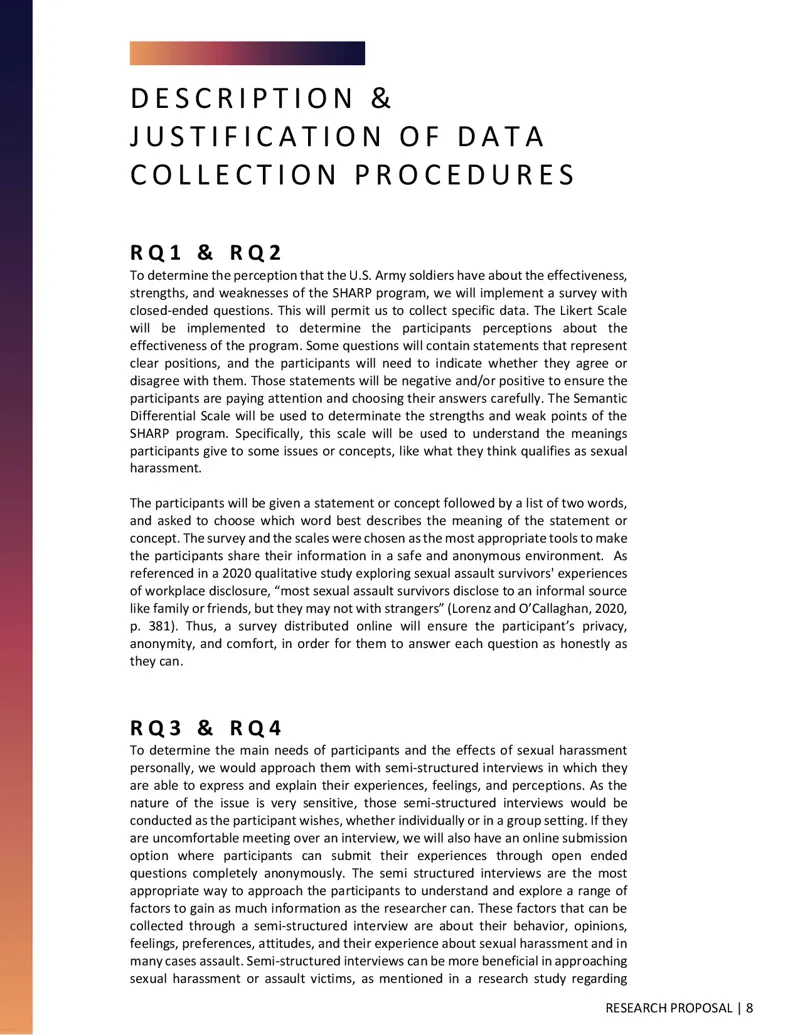
DESCRIPTION & J USTIFICATION OF DATA COLLECTION PROCEDURES
RQ1 & RQ2 To determine the perception that the U.S. Army soldiers have about the effectiveness, strengths, and weaknesses of the SHARP program, we will implement a survey with closed-ended questions. This will permit us to collect specific data. The Likert Scale will be implemented to determine the participants perceptions about the effectiveness of the program. Some questions will contain statements that represent clear positions, and the participants will need to indicate whether they agree or disagree with them. Those statements will be negative and/or positive to ensure the participants are paying attention and choosing their answers carefully. The Semantic Differential Scale will be used to determinate the strengths and weak points of the SHARP program. Specifically, this scale will be used to understand the meanings participants give to some issues or concepts, like what they think qualifies as sexual harassment.
The participants will be given a statement or concept followed by a list of two words, and asked to choose which word best describes the meaning of the statement or concept. The survey and the scales were chosen as the most appropriate tools to make the participants share their information in a safe and anonymous environment. As referenced in a 2020 qualitative study exploring sexual assault survivors' experiences of workplace disclosure, “most sexual assault survivors disclose to an informal source like family or friends, but they may not with strangers” (Lorenz and O’Callaghan, 2020, p. 381). Thus, a survey distributed online will ensure the participant’s privacy, anonymity, and comfort, in order for them to answer each question as honestly as they can.
RQ3 & RQ4 To determine the main needs of participants and the effects of sexual harassment personally, we would approach them with semi-structured interviews in which they are able to express and explain their experiences, feelings, and perceptions. As the nature of the issue is very sensitive, those semi-structured interviews would be conducted as the participant wishes, whether individually or in a group setting. If they are uncomfortable meeting over an interview, we will also have an online submission option where participants can submit their experiences through open ended questions completely anonymously. The semi structured interviews are the most appropriate way to approach the participants to understand and explore a range of factors to gain as much information as the researcher can. These factors that can be collected through a semi-structured interview are about their behavior, opinions, feelings, preferences, attitudes, and their experience about sexual harassment and in many cases assault. Semi-structured interviews can be more beneficial in approaching sexual harassment or assault victims, as mentioned in a research study regarding RESEARCH PROPOSAL | 8
experiences of sexual assault nondisclosure “interviews of sexual harassment survivors provide information that they were not aware of prior to the study” (Ullman et al.’s, 2010 p. 848). Based on this knowledge, we decided to conduct our survey with this structure.
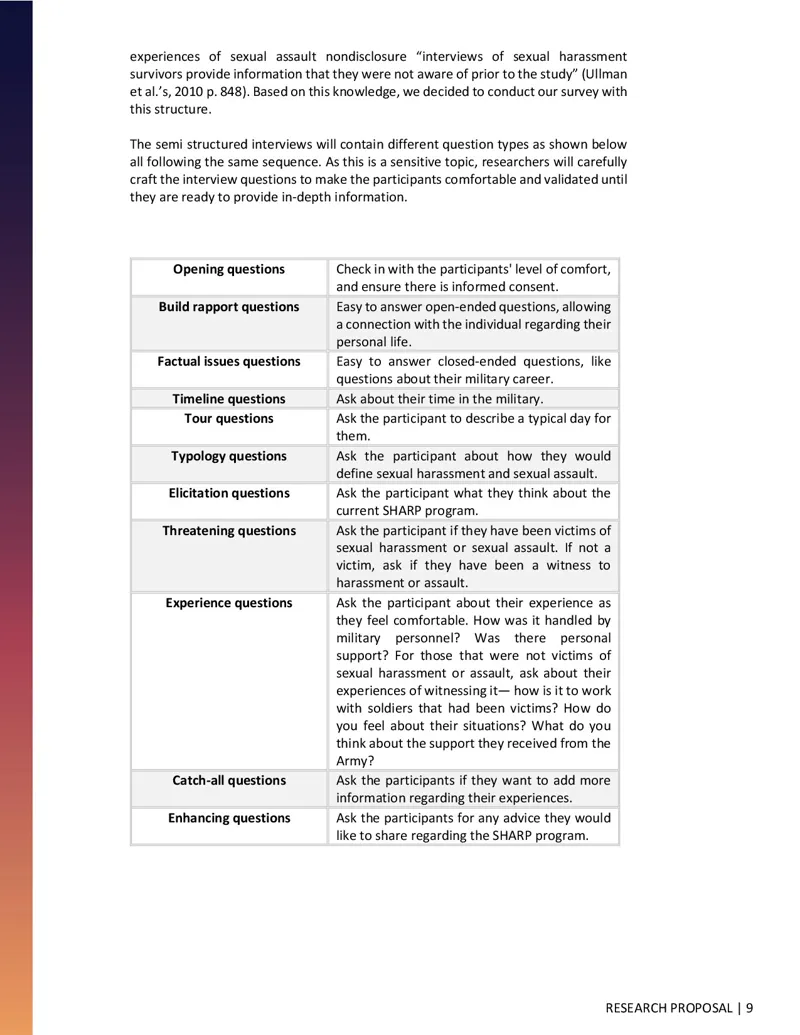
The semi structured interviews will contain different question types as shown below all following the same sequence. As this is a sensitive topic, researchers will carefully craft the interview questions to make the participants comfortable and validated until they are ready to provide in-depth information.
Opening questions Check in with the participants' level of comfort, and ensure there is informed consent.
Build rapport questions Easy to answer open-ended questions, allowing a connection with the individual regarding their personal life.
Factual issues questions Easy to answer closed-ended questions, like questions about their military career.
Timeline questions Ask about their time in the military. Tour questions Ask the participant to describe a typical day for them.
Typology questions Ask the participant about how they would define sexual harassment and sexual assault.
Elicitation questions Ask the participant what they think about the current SHARP program.
Threatening questions Ask the participant if they have been victims of sexual harassment or sexual assault. If not a victim, ask if they have been a witness to harassment or assault.
Experience questions Ask the participant about their experience as they feel comfortable. How was it handled by military personnel? Was there personal support? For those that were not victims of sexual harassment or assault, ask about their experiences of witnessing it— how is it to work with soldiers that had been victims? How do you feel about their situations? What do you think about the support they received from the Army?
Catch-all questions Ask the participants if they want to add more information regarding their experiences.
Enhancing questions Ask the participants for any advice they would like to share regarding the SHARP program.
RESEARCH PROPOSAL | 9
CONCLUSION DISCUSSION OF POTENTIAL FINDINGS AND CONTRIBUTIONS
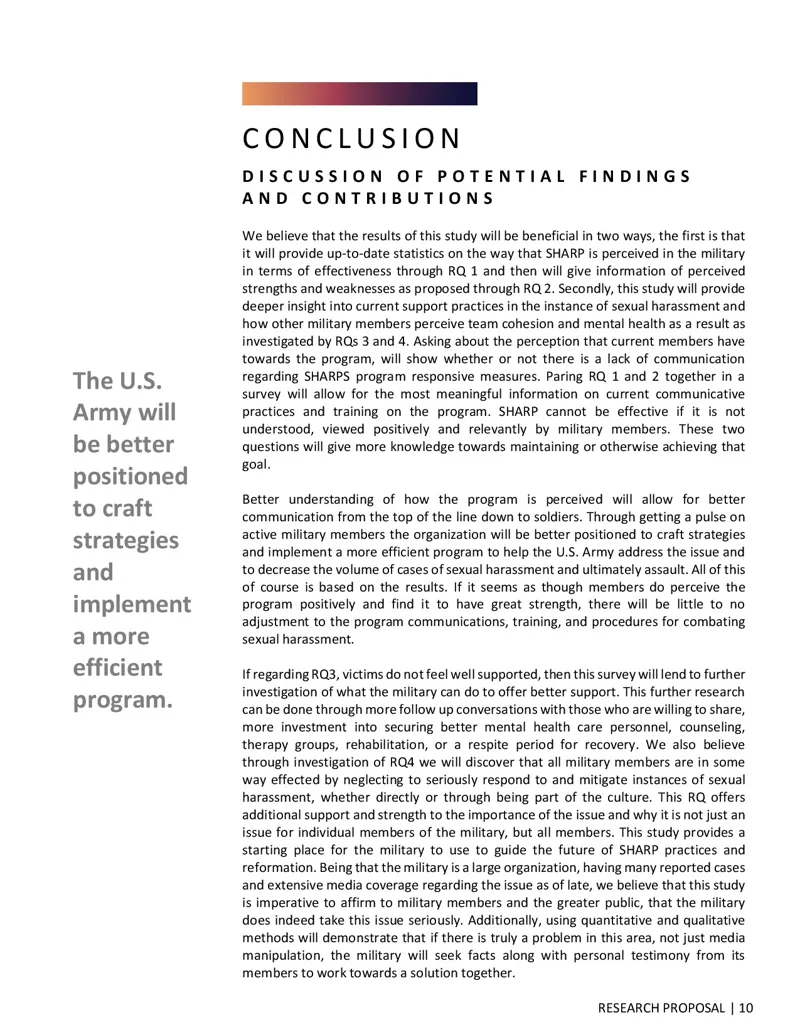
We believe that the results of this study will be beneficial in two ways, the first is that it will provide up-to-date statistics on the way that SHARP is perceived in the military in terms of effectiveness through RQ 1 and then will give information of perceived strengths and weaknesses as proposed through RQ 2. Secondly, this study will provide deeper insight into current support practices in the instance of sexual harassment and how other military members perceive team cohesion and mental health as a result as investigated by RQs 3 and 4. Asking about the perception that current members have towards the program, will show whether or not there is a lack of communication The U.S. regarding SHARPS program responsive measures. Paring RQ 1 and 2 together in a survey will allow for the most meaningful information on current communicative Army will practices and training on the program. SHARP cannot be effective if it is not understood, viewed positively and relevantly by military members. These two be better questions will give more knowledge towards maintaining or otherwise achieving that positioned goal.
to craft Better understanding of how the program is perceived will allow for better communication from the top of the line down to soldiers. Through getting a pulse on strategies active military members the organization will be better positioned to craft strategies and implement a more efficient program to help the U.S. Army address the issue and and to decrease the volume of cases of sexual harassment and ultimately assault. All of this of course is based on the results. If it seems as though members do perceive the implement program positively and find it to have great strength, there will be little to no adjustment to the program communications, training, and procedures for combating a more sexual harassment.
efficient If regarding RQ3, victims do not feel well supported, then this survey will lend to further program. investigation of what the military can do to offer better support. This further research can be done through more follow up conversations with those who are willing to share, more investment into securing better mental health care personnel, counseling, therapy groups, rehabilitation, or a respite period for recovery. We also believe through investigation of RQ4 we will discover that all military members are in some way effected by neglecting to seriously respond to and mitigate instances of sexual harassment, whether directly or through being part of the culture. This RQ offers additional support and strength to the importance of the issue and why it is not just an issue for individual members of the military, but all members. This study provides a starting place for the military to use to guide the future of SHARP practices and reformation. Being that the military is a large organization, having many reported cases and extensive media coverage regarding the issue as of late, we believe that this study is imperative to affirm to military members and the greater public, that the military does indeed take this issue seriously. Additionally, using quantitative and qualitative methods will demonstrate that if there is truly a problem in this area, not just media manipulation, the military will seek facts along with personal testimony from its members to work towards a solution together.
RESEARCH PROPOSAL | 10
REFERENCES Andrew, A. (2013, March). Leading Change: Sexual Harassment/Assault Response and Prevention (SHARP). Defense Technology Information Center. Retrieved April 19, 2022, from https://apps.dtic.mil/sti/pdfs/ADA589105.pdf
Harrati, S., Coulanges, M., Derivois, D., & Vavassori, D. (2018). Qualitative study on the traumatic experiences of female sex offenders. Journal of Loss & Trauma, 23(4), 271-286.
https://www.tandfonline.com/doi/abs/10.1080/15325024.2018.1436869?journalCode=upil20
Lorenz, K., & O’Callaghan, E. (2020). "I realized that I couldn't act normal": A qualitative study of sexual assault survivors' experiences of workplace disclosure. Journal of Family Violence, 37(2), 381- 393. https://link.springer.com/article/10.1007/s10896-020-00183-z
Stander, V. A., & Thomsen, C. J. (2016). Sexual harassment and assault in the U.S. military: A review of policy and research trends. Military Medicine, 181(1), 20–27. https://doi-org.proxyeast.uits.iu.edu/10.7205/MILMED-D- 15-00336
Ullman, S., O’Callaghan., Shepp, V., & Harris, C. (2020). Reasons for and experiences of sexual assault nondisclosure in a diverse community sample. Journal of Family Violence, 35(8), 839-851.
https://link.springer.com/article/10.1007/s10896-020-00141-9
United States Department of Defense. (2022). Sexual assault prevention and response report 2020. ASPR. https://www.sapr.mil/reports
Warmer, C., and Armstrong, M. (2020). The role of military law and systemic issues in the military's handling of sexual assault cases. Law & Society Review, 54(1), 265-300.
https://onlinelibrary.wiley.com/doi/abs/10.1111/lasr.12461
Wilson, L. C., Newins, A. R., Wilson, S. M., Elbogen, E. B., Dedert, E. A., Calhoun, P. S., Beckham, J. C., MIRECC Workgroup, V. M.-A., & Kimbrel, N. A. (2020). Self- and other-directed violence as outcomes of deploymentbased military sexual assault. Journal of Aggression, Maltreatment & Trauma, 29(6), 714–724. https://doiorg.proxyeast.uits.iu.edu/10.1080/10926771.2020.1725213
RESEARCH PROPOSAL | 11