Capstone
RUNNING HEAD: COMMUNICATION OF WOMEN IN ESPORTS 1 Capstone Research Project: Communication of Women in Esports Angel Ruzicka Indiana University CMCL-C490 Dr. Quenette March 25, 2022
The first 22 pages are shown here. The PDF has all 23.
The text
Read out of the PDF, so the order can be a little off where the page had columns or boxes. The pages above are the real thing.
RUNNING HEAD: COMMUNICATION OF WOMEN IN ESPORTS 1 Capstone Research Project: Communication of Women in Esports Angel Ruzicka Indiana University CMCL-C490 Dr. Quenette March 25, 2022
COMMUNICATION OF WOMEN IN ESPORTS 2
Abstract The topic of women in sports and the inequalities they face has gained more traction over the past few years, but how does this transfer over to esports? One can draw parallels between traditional sports and esports, but competitive video gaming is a growing industry that needs addressed as its own entity. The mistreatment of women within the esports industry needs to be addressed, but the issue is that women and femme-identifying people already face suppression of their opinions and game knowledge in-game. This leads to the question of “How can women effectively speak out against the sexism within the esports industry and stimulate change against the discrimination women face?” Based on the limited research out there and survey responses, one can see that although difficult, by coming together, women in gaming can overcome these societal norms and discrimination they face in the esports industry.
COMMUNICATION OF WOMEN IN ESPORTS 3
Capstone Research Project: Communication of Women in Esports Sexism and discrimination towards women are nothing new in the world today, and this is applicable to the gaming industry as well. Women are not taken seriously no matter what their credentials are. Within esports, whether it be playing, commenting/casting, or management, women have been downplayed and treated as unequal in comparison to their male counterparts. Not only are women discriminated against within the esports scene, but there is also a lack of research regarding women in gaming. Most of the research and statistics out there are focused on gamers who identify as male, which is not representative of the plethora of women involved within the gaming scene. The objective of this paper is to discuss the issues within the gaming industry for women and how women can effectively speak out against the sexism and discrimination within the industry to constitute change. With the lack of representation of women, more research needs to be conducted regarding the representation of women and how to come forward about the discrimination they face in the industry. Lack of representation and lack of research both make the esports industry difficult for women to navigate, and as discrimination and sexism continues to happen, it is important for women to be able to effectively communicate their experiences without facing repercussions for doing so.
Research Literature Review With the lack of research regarding women and femme-identifying gamers, the purpose of the literature review is to analyze the research that does exist and draw new conclusions on how communication for women within the esports community should be handled. Some comparisons will be drawn to women in traditional sports, and based off this, recommendations and ideas regarding the newly emerging esports world will be provided. While the sources included in this literature review are by no means all of the research conducted on women, these
COMMUNICATION OF WOMEN IN ESPORTS 4
sources have been chosen due to their representativeness of the small research that there is on the subject. The purpose of this will be to understand how women can effectively communicate their grievances in such a male-dominated field.
Lack of Inclusivity Women within the esports realm are not given ample opportunities within the gaming industry. Whether one looks from a competitive perspective or a development perspective, women are severely underrepresented. Many professional esports teams are comprised solely of men, and most teams for game development or organizations are comprised of men as well. Although there are women getting involved in gaming, they often are not given the same opportunities or looked at in the same light that men are. Esports, like traditional sports, have seemed to favor men’s performances only. Traditional sports enacted Title IX to combat the lack of inclusion of women for sports (Darvin et. al., 2020, p. 37). Women can band together to create such rules and legislation within the esports realm as well. While there has been a rise in women’s leagues, teams, and tournaments, it does not even come close to comparing with the opportunities that men have. Women have seemed to gain more support and traction within the industry, but it is crucial to not be fooled by a fake mask of support (Salter & Blodget, 2012). Women still suffer from a severe lack of inclusion and support.
A larger push for Title IX inclusion could inevitably help the state of women in competitive esports. If the governing bodies of esports events and competitions would include policies such as Title IX, there could be an increase in opportunities for women. Title IX was instated to give women equal opportunity in sanctioned sports. While there are multiple facets of Title IX, one of the biggest and most important parts is proportionality. Proportionality is about the percentage of school composition is comparable to those represented in the school’s sports.
COMMUNICATION OF WOMEN IN ESPORTS 5
This mean that “schools need to ensure those ratios are close. Say, for instance, a school’s student body is 55 percent female. In order to comply with Title IX, that school would need to make 55 percent of its athletic opportunities available for girls or women” (Axon, 2018, p. 24). This proportionality factor could be worked into the esports realm in a variety of different ways. For example, competitive esports organizations on the largest scale could provide demographic information that these organizations could follow.
Geek Masculinity Women are often disregarded as being true gamers compared to men, and their gameplay is not based on their performance whatsoever. The research found that roots in gaming were mainly men in a term coined as “geek masculinity” according to authors (Easpaig, 2018, p. 130). Although those relating to the term were deemed as the outside crowd to many, the community began to create other outsiders, such as women and other minorities. While the geek masculine men were once the “freaks” of society, they banded together and forced other people, such as women, to be viewed as the marginalized group who did not fit into the gaming sphere. Women can use this as an opportunity to relate with other minorities in the gaming realm and work together to become the majority.
By breaking these gendered stereotypes and effectively communicating, gaming spaces can start to be changed for the better. The authors state that “there is transformative opportunity for safe and inclusive spaces” (Easpaig, 2018, p. 131). By working with other people within the gaming realm, these spaces can be created to make a safer, more enjoyable experience for gaming as a whole. By refusing to leave the gaming scene and voicing their love for gaming, women can overcome the typical archetype of geek masculinity and push for more inclusion past this one sole group. It is said that “video games can often reinforce hypermasculine stereotypes
COMMUNICATION OF WOMEN IN ESPORTS 6
despite the continued tension of geek ‘masculinity’ as defined in opposition to athletic masculine norms” (Salter & Blodgett, 2012). This idea of geek masculinity was made to differentiate male gamers from these traditional masculine athletes, but that identity does not have to force women out of the gaming sphere. Women can co-exist within the gaming sphere while gamer men can still have their space away from traditional athletes. Although gendered stereotypes are common in gaming, women speaking out and showing their presence can ultimately change these perceptions that are rooted into the history of gaming.
Covering New Grounds There is very little research conducted about female gamers. Easpaig relies on the use of constructivist grounded theory throughout his scientific process of studying sexism in gaming and how it “orients towards social processes, facilitating an exploration of what is achieved and how it is achieved in the text” (2018, p. 126-127). Constructivist grounded theory relies on the ideology that there is not enough research within the area, so there is an inductive research method involved to help garner this information. This theory makes sense in relation to women facing sexism in online gaming spaces since there are not much research within the area quite yet. It allows for theoretical interpretation and the ability to understand how communication takes place. Lopez-Fernandez, Williams, Griffiths, and Kuss found that there is virtually no research within the realm of gaming addiction and negative effects of gaming on women (2019). The fact that there is a lack of research regarding women’s gaming addiction, but there is research for men regarding this area is sexist within itself. There is no reason that gaming addiction should even be a gendered topic, but most of the previous research has been geared towards men.
COMMUNICATION OF WOMEN IN ESPORTS 7
The only research that is prominent for women is the amount of harassment and discrimination that they face in online gaming. It is an issue within itself that the only research existing about women in gaming is the lack of positive treatment that they receive. Pew Research found that “while most online environments were viewed as equally welcoming to both genders, the starkest results were for online gaming. Some 44% of respondents felt the platform was more welcoming towards men” (Duggan, 2020). A severe lack of a space within women gaming can be overcome through the creation of groups strictly for women. A great place to do this is within Discord, as there are already many women and femme-identifying-focused groups, such as “the*gameHERs” and “Queer Women of Esports” discord servers. There is a need to research more women in gaming and to combat the lack of acceptance towards women within online gaming. Methods Research Question: How can women effectively speak out against the sexism within the esports industry and stimulate change against the discrimination women face? To address this research question, this project uses qualitative research. I conducted a survey distributed towards women in gaming that investigated how women are treated while they game and/or stream and what these effects can have on the women. The survey was comprised of multiple different sections: demographics, gaming experience, effects, and opportunities. The demographic section at the beginning helped identify who was taking the survey. The gaming experience section focused on any negative encounters that women and femme-identifying people had gone through while either gaming or streaming; respondents had the opportunity to
COMMUNICATION OF WOMEN IN ESPORTS 8
elaborate on these events, if they wished. The effects section delved into how these negative experiences of discrimination, sexism, etc. affected their gameplay and their desire to be included within the gaming community. Lastly, the opportunity section revolved around respondents’ opinions on whether women in the esports world have ample opportunities to compete and be recognized.
Qualitative research is essential for this research project. While research regarding women within the gaming industry is lacking overall, the little research that does exist is typically quantitative research. However, qualitative research much better suits this research project to not only understand the troubles for women within the gaming industry but to also suggest ways to change this industry for the better. Qualitative research is particularly helpful for this research project as it “allows researchers to be far more speculative about what areas they choose to investigate and how to do so… Qualitative research can be more targeted” (Vaughan, 2021). Therefore, taking the route of qualitative research for this project allowed the researcher to target a narrow population and draw conclusions regarding women’s treatments in the gaming world.
The survey was used to collect data on how women within the gaming industry feels. Respondents were asked to fill out a short survey about sexism and discrimination that they may have faced throughout their gaming experiences. This qualitative data was gathered, and similar responses were grouped together to give an idea of how prevalent these negative issues still are within today’s gaming scene. Women have greatly lacked opportunities compared to men. Even in the traditional sports world, women are portrayed differently on social media and treated poorly while involved in casting. This survey gathered additional information about women’s
COMMUNICATION OF WOMEN IN ESPORTS 9
feelings concerning their treatment while gaming and showed the need for change within the industry.
Data Collection The survey was created on Qualtrics and distributed in multiple different Discord servers for female-identifying gamers to complete. The link was provided for female-identifying gamers to view and respond to if they were interested. There was nothing offered to respondents for completing this survey. Qualtrics has in-depth organization software that allows for easy access to the researcher. Most of the research is qualitative, but there are some quantitative questions as well to understand the severity of the issue. The few questions that are quantitative will be compiled into a graphic to use for the project. Other qualitative survey questions will be categorized dependent on the responses of experiences regarding discrimination and sexism. Respondents of the survey had five days to answer the survey questions. Overall, the purpose of the survey is to provide an understanding of different female gamers’ issues within the industry and allow the gamers to voice their emotions regarding their experiences. The use of a in-depth, qualitative survey allows the ability to apply context to real-life experiences and the discrimination they have faced in gaming.
Results The results of this survey were collected over a Qualtrics-administered survey. The survey had 16 respondents total. The survey provided both quantitative and qualitative data for the purpose of dissecting women in the gaming realm. Questions were focused on the experiences of women and femme-identifying people during gaming, streaming, and communicating within the industry.
COMMUNICATION OF WOMEN IN ESPORTS 10
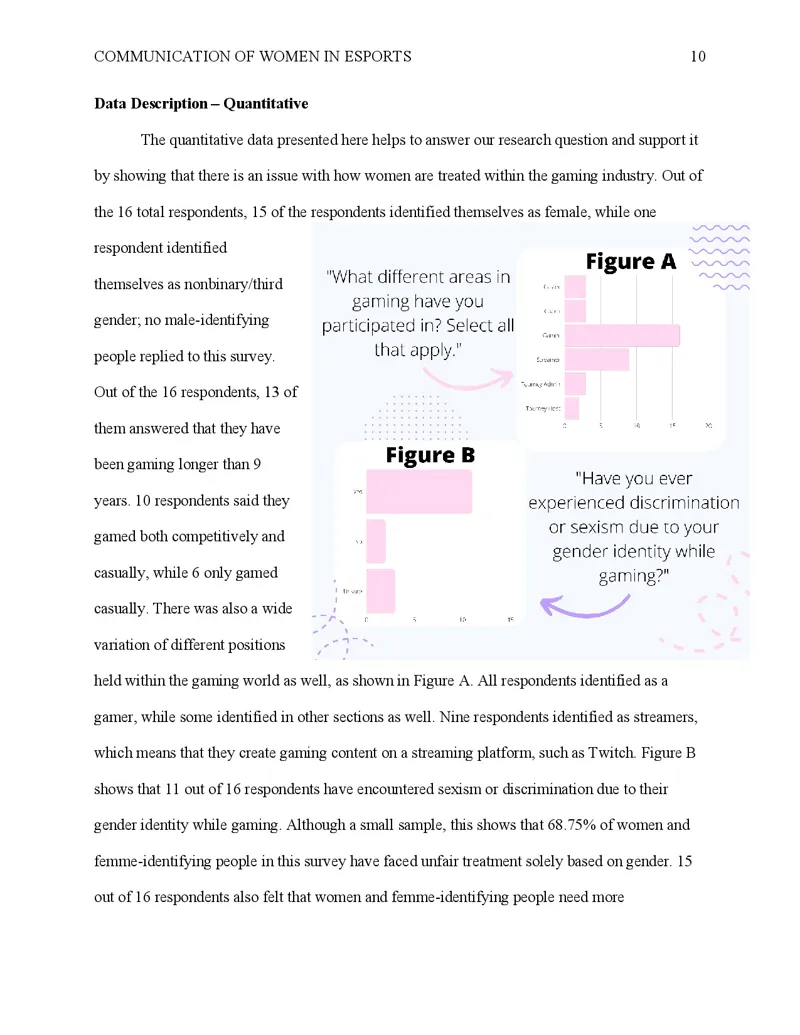
Data Description – Quantitative The quantitative data presented here helps to answer our research question and support it by showing that there is an issue with how women are treated within the gaming industry. Out of the 16 total respondents, 15 of the respondents identified themselves as female, while one respondent identified themselves as nonbinary/third gender; no male-identifying people replied to this survey.
Out of the 16 respondents, 13 of them answered that they have been gaming longer than 9 years. 10 respondents said they gamed both competitively and casually, while 6 only gamed casually. There was also a wide variation of different positions held within the gaming world as well, as shown in Figure A. All respondents identified as a gamer, while some identified in other sections as well. Nine respondents identified as streamers, which means that they create gaming content on a streaming platform, such as Twitch. Figure B shows that 11 out of 16 respondents have encountered sexism or discrimination due to their gender identity while gaming. Although a small sample, this shows that 68.75% of women and femme-identifying people in this survey have faced unfair treatment solely based on gender. 15 out of 16 respondents also felt that women and femme-identifying people need more
COMMUNICATION OF WOMEN IN ESPORTS 11
opportunities within the gaming community through tournaments, gaming organizations/communities, and casting opportunities. The last piece of crucial quantitative data is that respondents were asked if they feel that women and femme-identifying people in gaming can speak out about their experiences without ridicule, and 12 out of 16 respondents answered either “probably not” or “definitely not.” Overall, this quantitative data shows us the demographics of the respondents and how they feel regarding the experiences of women and femme-identifying people within the gaming industry.
Data Description – Qualitative The qualitative section of the survey helps us understand how communication has been difficult for women within the gaming industry. Many shared their negative experiences, supporting the idea that it is more difficult for women to communicate within the esports industry. If respondents had negative experiences due to their gender identity during gaming and streaming, they were asked to provide context if they felt comfortable enough to share. Overall, 11 out of the 16 respondents provided more context into the descriptions of their experiences with discrimination, sexism, hatred, etc. focused on their gender identities. These were optional as this is a potentially triggering subject, and for the safety of this research, the goal was to not trigger anyone’s past trauma or anxiety that may have been associated with these events. Four respondents have been attacked on stream by male-identifying people based on either how they look or how well their stream was doing, providing unwanted commentary such as, “you are only getting views since you are a girl.” Six other respondents shared that during voice communications in-game, men would pry on the women or femme-identifying people if they tried to use communications as well. One respondent even mentioned that they received hate ingame for solely having a feminine name. Based on these responses, there seems to be an
COMMUNICATION OF WOMEN IN ESPORTS 12
overwhelming consensus that women are viewed differently than their male counterparts while gaming and streaming.
Four respondents have considered either quitting gaming or streaming due to the hate that they have received. Six respondents said that they have felt unwelcome in the gaming community before, but they refused to quit gaming despite what their male counterparts had to say regarding their participation. When questioned about the levels of comfortability regarding speaking out against hate towards women and femme-identifying people, nine respondents said they would not feel comfortable doing so again, as they have previously faced backlash regarding their experiences. Six others said that they will continue to speak out regardless of backlash they may face. Two chose not to respond to this question.
When asked to elaborate on the additional opportunities that women need in gaming, one respondent felt that there were no additional opportunities needed. Two respondents felt that women’s tournaments should not be separated from men’s tournaments. Nine other respondents voiced how opportunities are necessary in multiple realms but specifically tournament settings and gaming communities. Many of these respondents felt that women are underrepresented and want their voices to be heard more. When asked about representation and equal opportunity in the esports scene, ten out of eleven respondents to this question felt that the biggest problem is the lack of women included on professional teams and esports organization. One respondent felt that the biggest problem was the inequality of pay that women face in comparison with their male counterparts.
Data Interpretation While not all 16 respondents participated in the qualitative responses to the survey, the majority of respondents that did had aligning viewpoints regarding women and gaming. There
COMMUNICATION OF WOMEN IN ESPORTS 13
was a major trend towards the treatment of women within games. One of the biggest trends throughout the survey was the suppression of women and femme-identifying voices. Many respondents felt that they could not even use in-game voice communications out of worries that their teammates would give them a hard time solely for their gender identity. Not only were women and femme-identifying people afraid to use in-game communications, but there were also a group of respondents that felt they would face ridicule about trying to speak out about their experiences. This illustrates that even if this population would want to speak out, there is a common understanding of the suppression of female and femme voices. One respondent had a negative experience with in-game communications during Call of Duty, directly supported this idea. This respondent said that her “first experience was having my gender used as a reason to not play Call of Duty. Men would make remarks of how I am better off in a kitchen more than a Team Deathmatch game.” This same respondent said that in another match, though, when she used in-game voice chat, some men ridiculed her while others fetishized her and tried to flirt with her, ending up leading to in-game sexual harassment. This anonymous respondent needs to be able to freely communicate with her team in-game without the fear of being sexually harassed or unfairly criticized solely for identifying as a woman.
Another suggestion by the data was the severe underrepresentation of women. Seen throughout multiple quantitative and qualitative questions in the survey, most respondents felt that women do not get the same opportunities as men in the first place when it comes to gaming. So not only do women not get ample opportunities than men, but when they do, they often face hate and discrimination for being an emerging woman within the gaming world. For example, one respondent felt that any time her team loses, she is instantly blamed as the reason. This respondent said that “I will encounter men (it's always been masculine voices, anyway) who will
COMMUNICATION OF WOMEN IN ESPORTS 14
not say a damn word the whole match until we lose, only to unmute and vent their frustrations on me. "Bitch," "Cunt," "E-Girl," are wielded like weapons.” In the competitive gaming realm, this shows that women have to by hyper-vigilant about their surroundings just to not have their own gender identity held against them. The weaponization of womanhood within game communication can result in women being pushed out of the gaming industry as a whole. If more women come forward about their experience, it could have an influence on gaming companies cracking down on harassment within in-game voice communications. Many game titles already have reporting available, but a push for harsher repercussions could start curbing the amount of harassment incidents towards women. This can help protect women so that they can communicate more effectively and not have to deal with anyone degrading them for how they sound or how they perform in their games.
Another trend that was found is that many women and femme-identifying streamers had experiences that targeted them while trying to stream games. One streamer survey respondent reported that their stream “was attacked by bots on multiple occasions, targeting the fact that I am a trans woman.” They faced attacks that not only devalued their work but contributed their success to being a woman. There seems to be a stark dichotomy here within the gaming realm; women and femme-identifying streamers are criticized for entering the gaming sphere due to their gender, but then, if they have success in a realm such as streaming, it is solely due to being a woman. Another survey respondent who streams said that she has been “getting told I have viewers ‘because I’m a girl’ or that ‘twitch is easy for you as a girl,’ getting dodged in ranked games because I speak, and they don’t want to play with a woman getting told to go to the kitchen. All because I made a callout in the match, and everyone knows I’m a girl now.” This user experiences this exact dichotomy of being told that they succeed on stream for being a
COMMUNICATION OF WOMEN IN ESPORTS 15
woman, but they face ridicule in their game lobbies for their gender identity. It is a double-edged sword that many women have to endure if they decide to get involved within gaming and streaming.
Some men have drawn conclusions that women streamers are using their bodies to gain viewers and followers while streaming, which links to another general issue of society regarding the sexploitation of women. A third female-identifying streamer who responded to the survey reported that “During a charity gaming marathon in which a friend and I were both in cosplay, a chatter continuously kept asking for my "fat ass" to move out of focus so my much thinner and apparently prettier friend could be the main focus. Neither of us were actively playing the game at the time.” Nevertheless, it seems that in the streaming world, men and male-identifying people did not credit women’s success towards their talent, professionalism, or skill and immediately discredited any of these possibilities due to the streamer’s gender identity. These trends throughout the data illustrate that women may have a hard time speaking out about their experiences due to identifying as a woman or as a femme.
Discussion One important step that women can take is to, despite criticisms they may face, is discuss this lack of inclusivity and work to change it. By rallying together, women can push for leading esports organizations and governing bodies to push for equal rights. Some organizations, such as Dood Gaming and His & Hers, offer all-women tournaments in various esports titles like Apex, Valorant, Call of Duty, Overwatch and more. One of the easiest achievable solutions for women is to spread the word about these types of events, so these events can gain traction and continue to prosper and evolve. More women and femme-identifying people competing means that more lobbies can open, and there will be more competitions focused on women competitors. This
COMMUNICATION OF WOMEN IN ESPORTS 16
creation of more lobbies and opportunities can tie in well with Title IX; if more women use word-of-mouth to spread opportunities in the gaming industry, it is likely that more women will join these tournament lobbies. In traditional sports, author Rachel Axon says that “where doors have been opened for [women] to participate, they have rushed through and embraced sports and all its benefits” (2018, p. 41). It is likely that this parallel would be drawn towards esports as well if women are offered the same types of opportunities.
When asking for more information regarding their women’s tournaments, Dood Live’s owner Vladimir Rigenco said that Dood has seen a “large increase” in the number of women participating, and they are working with EA to develop an All-Women’s League for Apex. There is currently an EA-ran Apex league, but most of these participants are male-identifying, which could be because women do not feel welcome on these teams. Women, if given the opportunity, could prove themselves if given the chance as “One study found that if women play as often as men, they tend to reach similar levels of success within the game, discouraging the belief that women are less skillful at gaming” (Lopez et. al., 2019). This begs the question that are women truly offered equal opportunities as their male counterparts? It seems that they are not, and with enough organized protest, women can overturn these inequalities. Effectively communicating these inequalities is crucial to bring light to the issues of gender inequality that competitive gaming has.
In all-women spaces, women and femme-identifying people can feel free to openly communicate with other like minds and identities without the fear of being discriminated against due to having a feminine voice or in-game name, as many survey respondents have endured. This can allow women to communicate freely in an opening, more welcoming environment. It is important to note that “in a survey distributed among popular esports-related Reddit discussion
COMMUNICATION OF WOMEN IN ESPORTS 17
boards, women were found to experience discrimination in gaming at higher rates than men were. Men also did not seem to fully see the exclusivity that women faced within the sphere” (Darvin, et. al., 2020, pp. 41-42). By creating certain spaces for women, inherent sexism could be alleviated and increase the opportunities for women to effectively communicate. Right now, many women are too afraid to even utilize in-game voice communications, so being able to build their confidence back up within safe environments is crucial. One survey respondent felt that women needed “more environments where they don’t have to worry about anyone considering their gender to even be a factor.” All-women tournaments provide opportunities where women and femme-identifying people do not have to second guess their femme voices or their gender identities when using in-game communications, showing that these tournaments can create a safer environment for women to compete.
Another important way that women can influence and change the communication of the esports scene is push for different policies within esports tournament hosts and organizations. Research supports the narrative that women are targeted in gaming: “Consistent with media reporting, a growing body of scholarship has identified the presence in gaming environments of what is known colloquially in online spaces as “flaming” - abuse, including sexually derogatory comments, directed at female players” (Easpaig, 2018, p. 122). The validation of women’s stories can be extremely important when women are coming forward their negative experiences in gaming. If women come with such statistics towards esports organizations, there is a greater chance to stimulate change as their arguments will be supported by data. Posting their own experiences can be helpful in spreading an awareness that these cases still happen but bringing an organized argument to organizations could stimulate change within the gatekept industry. There is starting to be talk about the inclusion of women, but “while these new media open
COMMUNICATION OF WOMEN IN ESPORTS 18
discussions of the publics to many new populations, they also reinforce many of the problematic issues that remain fundamentally unaddressed” (Salter & Blodgett, 2012). There may be some backlash initially, but if an abundance of organizations and hosts start changing their policies to provide equal opportunity for women, it will force the narrative that this industry is a place for women as well.
Ignoring backlash can be hard, but it has proven to be effective and with numbers on the side of women, it may be the way to stimulate the most change. Research found that “60% of those who have experienced online harassment said that they elected to ignore the behavior. When asked if they felt ignoring it was effective at making the situation better, 83% answered affirmatively and 17% were not satisfied” (Duggan, 2020). So perhaps the best thing to do in these situations are to ignore the harassers and rely on support from girl gamer groups. By banding together, women can learn to support each other, providing consolation, and educating each other on how to handle harassment and sexism in online gaming communities. While it may seem simple, sticking together and ignoring the hate could help shut down the internet bullies and make online gaming a safer place for women.
Lastly, participating in not only the gaming side of the industry could help as well. While women and femme-identifying people should absolutely push for gaming and streaming opportunities, it is important for women to contribute to other areas if possible as well. For example, being willing to be research subjects for potential research studies could help give necessary data and voice women’s opinions within the esports realm, as my survey did – even if it is on a small scale. Also, if more women try to enter the esports industry as analysts, casters, and coaches, there will be more platforms for women to effectively communicate. Drawing yet
COMMUNICATION OF WOMEN IN ESPORTS 19
another direct parallel to traditional sports, it is likely that women would have more opportunities overall in employment opportunities outside of being a traditional gamer. Axon said that “As advocates fought for Title IX in the decades after it passed, women in sports journalism fought for equity as well. While male reporters could go into locker rooms to interview athletes, female reporters were commonly barred from doing that into the 1980s” (2018, p. 43). While these women may face backlash, if they are able to push through, women’s inclusivity could easily become the norm for esports.
Limitations and Future Research This study had some limitations that did affect the outcomes of the research. The survey was mainly distributed on Discord, and many (not all) of the Discords were in communities solely for women; therefore, due to the space that they had already elected to be in, this may have skewed survey responses. Time and sample size were also a constraint, as the survey had 16 total responses in a week’s time. While this sample size could suffice for qualitative data, it would have been much more helpful to have an increase in responses for quantitative data trends. Therefore, for the quantitative aspect of this research, these surveys would need to be mass distributed to women and femme-identifying people and garner a population size of preferably 500+ to accurately represent women and femme-identifying gamers. The qualitative side of the survey would not need as many respondents, but deeper analysis would be beneficial with the potential for in-depth one-on-one interviews as well.
For future research, an expanded survey with an increased length of time and amount of distribution channels would be preferred. Case analyses regarding the social media presence of women in professional gaming organizations and female casters and analysts would also be conducted and compared to trends found in the survey. These case analyses would be long-term
COMMUNICATION OF WOMEN IN ESPORTS 20
studies, likely taking at least a year in time, to fully encapsulate how each major gaming organization showcases, highlights, and talks about their female gamers and how casters and analysts are treated while covering an esports event.
Conclusion Women have been dealt the lower hand when it comes to representation and inclusion in the esports industry, but this does not mean that it must stay this way. There is a lack of both research and numbers in organizations regarding women, but there are undoubtedly women within the gaming industry looking for opportunity. According to the survey conducted, many women and femme-identifying people have been the target for discrimination, sexism, and other hate solely based on their gender identity. Although it may not be easy, it is vital that women keep talking about their experiences. While there may be backlash involved, having a support group of other women gamers will greatly help the mental fortitude of women that may be the target of this discrimination. Joining and supporting pro-women and femme-identifying groups can provide a sense of community and give the opportunity to share and communicate past experiences on a larger scale and platform. Lastly, not shying away from positions – either as a gamer, streamer, host, analyst, etc. – in the esports industry will help change the narrative of this currently male-dominated field. Esports is a place for everyone, and effective and thorough communication of women is the best place to start.
COMMUNICATION OF WOMEN IN ESPORTS 21
References Axon, R. (2018). Title IX levels the playing field. Abdo Publishing. https://web-p-ebscohost com.proxyeast.uits.iu.edu/ehost/ebookviewer/ebook/ZTg2MHhuYV9fMTQ5MTQyNF9f U41?sid=a99044a8-052d-4458-8108-4dc7400063de@redis&vid=0&format=EB&rid=1 Darvin, L., Vooris, R., & Mahoney, T. (2020). The playing experiences of esport participants: Analysis of treatment discrimination and hostility in esport environments. Journal of Athlete Development and Experience, 2(1), 36–50.
https://pdfs.semanticscholar.org/e5d1/b2c5aec1b2cf6815c1a6d9d8f61fc452d052.pdf Duggan, M. (2020, August 17). Online harassment. Pew Research Center: Internet, Science & Tech. Retrieved February 4, 2022, from https://www.pewresearch.org/internet/2014/10/22/online-harassment/ Easpaig, B. N. G. (2018). An Exploratory Study of Sexism in Online Gaming Communities: Mapping Contested Digital Terrain. Community Psychology in Global Persepctive, 4(2), 119–135. https://researchmanagement.mq.edu.au /ws/portalfiles/portal/93946828/Publisher_version_open_access_.pdf Lopez-Fernandez, O., Williams, A. J., Griffiths, M. D., & Kuss, D. J. (2019, July 10). Female
COMMUNICATION OF WOMEN IN ESPORTS 22
gaming, gaming addiction, and the role of women within gaming culture: A narrative literature review. Frontiers. Retrieved February 4, 2022, from https://www.frontiersin.org/articles/10.3389/fpsyt.2019.00454/full Salter, A., & Blodgett, B. (2012, September 11). Hypermasculinity & Dickwolves: The contentious role of women in the new gaming public. Taylor & Francis Online. Retrieved February 4, 2022, from https://www.tandfonline.com/doi/full/10.1080/08838151.2012.705199 Vaughan, T. (2021, August 5). 10 advantages and disadvantages of qualitative research. Poppulo. Retrieved February 19, 2022, from https://www.poppulo.com/blog/10 advantages-and-disadvantages-of-qualitative-research